

Content Warning: This blog contains references to sexual violence, hospitals, and forensic medical exams.
For those raised on Grey’s Anatomy or ER, one may not think of medical dramas as being incredibly accurate. From musical episodes to statistically impossible emergencies, our favorite medical television shows tend to be drama first, medicine second.
That’s one reason why The Pitt has stood out. The HBO Max series follows an emergency room shift in Pittsburgh, with each episode covering one hour of the day. Their realistic portrayal of the challenges facing healthcare workers in America, and the accuracy of their medical depictions, has made it one of the top television series currently on TV.
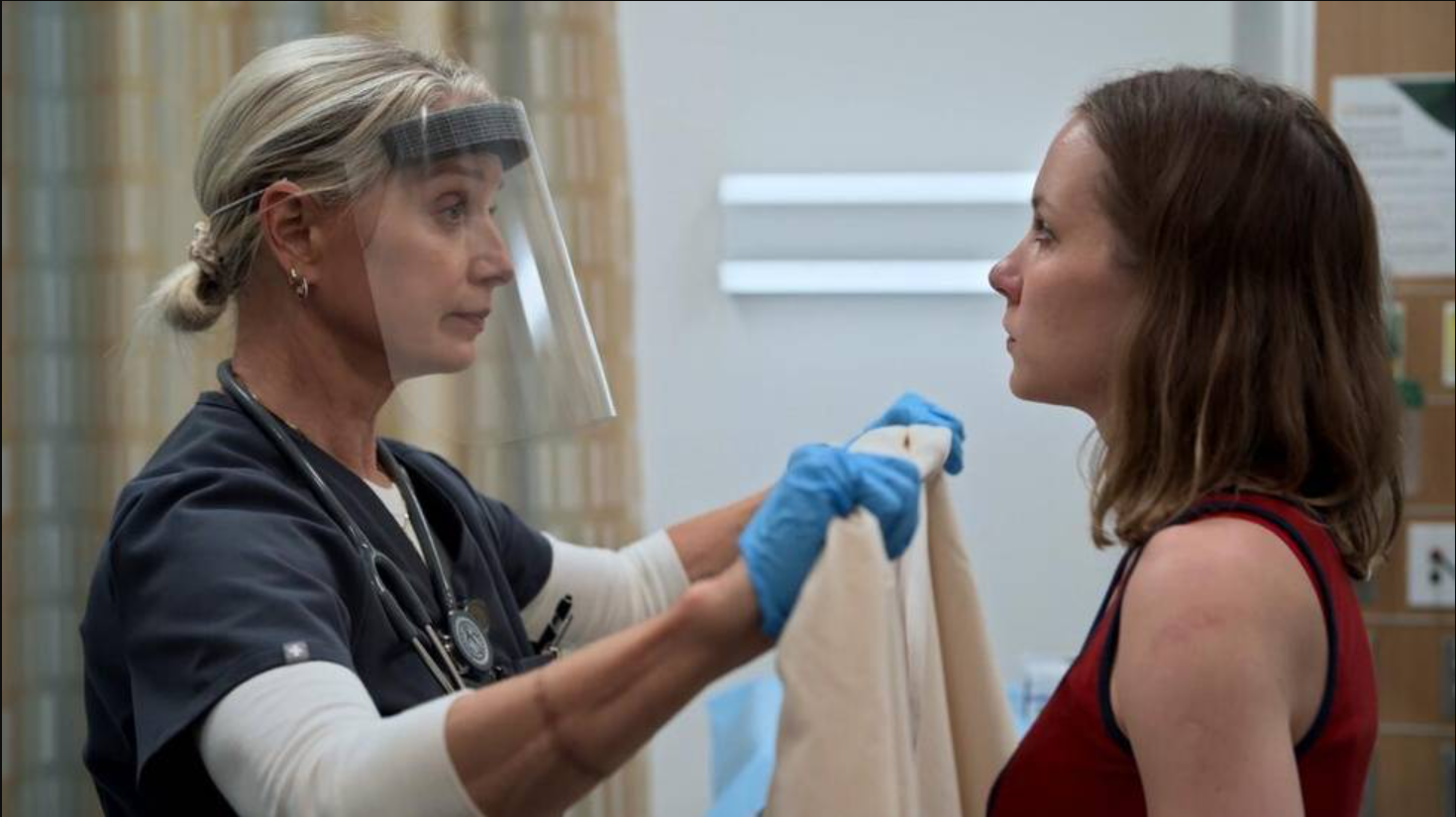
In the recent episode “1:00 PM,” a survivor comes into the emergency room after experiencing a sexual assault. Instead of following the storyline that many medical and crime shows do by focusing on the violence that occurred, the show chooses to center on the compassion of SANE nurses. What follows is a thoughtful depiction of a sexual assault examination. Here’s what The Pitt got right.
What is a SANE?
Sexual Assault Nurse Examiners, commonly referred to as SANEs, are registered nurses with specialized training in forensic evidence collection, trauma-informed care, and medical treatment for sexual assault survivors.
During the episode, we meet Ilana, a young woman who has experienced sexual assault. Charge nurse Dana Evans, played by Katherine LaNasa, is the only certified SANE on shift and guides Ilana through the forensic medical exam process.
While television often refers to “rape kits” in passing, we rarely see what that process actually involves when a body becomes evidence. A forensic medical exam is an hours-long experience with swabbing, photo documentation, and so much more. What The Pitt captures particularly well is the balance SANEs maintain between clinical precision and compassionate emotional support. Throughout the exam, Ilana is reminded that she has control over what happens next. Every step is explained. Consent is checked repeatedly.
Some of the SANE-designated hospitals in Greater Boston:
- Beth Israel Deaconess Medical Center
- Boston Medical Center
- Brigham and Women’s Hospital
- Cambridge Hospital
- Mount Auburn Hospital
- Boston Children’s Hospital
- Massachusetts General Hospital
- Newton-Wellesley Hospital
What Happens During a Sexual Assault Forensic Exam?
In this episode, we see the detailed process of conducting a sexual assault medical forensic exam.
First, the examiner obtains a thorough medical history from the survivor. The survivor stands on a large sheet of paper while undressing to catch any hair or fiber evidence that may fall from their body. The clothing and the sheet are then collected for testing for additional evidence. During a physical examination, any injuries from the attack are documented and treated, and evidence is collected.
The examiner collects biological evidence such as saliva, blood, semen, urine, skin cells, and hair by taking swabs of the survivor’s skin, genitalia, anus, and mouth, and scraping under the survivor’s fingernails. The survivor’s body is photographed head to toe to preserve evidence of bruising and injuries.
When the forensic medical examination is complete, the evidence collected is carefully packaged and labeled to prevent contamination. While collecting evidence is helpful should the survivor wish to make a report, the survivor does not have to report the crime to have an exam.
Support in the Emergency Room
One of the most incredible details included is that before the exam begins, Ilana meets a medical advocate from Pittsburgh Action Against Rape, who was called by the hospital when they learned a survivor was coming. When the advocate arrives, she introduces herself and lets Ilana know that she can stay with her during the exam if she would like additional support.
It is a survivor’s right to have an advocate present, and it is also their right to say no. While Ilana chooses not to have a medical advocate sit with her, the advocate mentions that she can reach out any time.
Medical advocates are a critical resource for survivors in the moments after an assault. Hospitals can be incredibly stressful, and medical jargon can be difficult to understand. Advocates act as a support system for a survivor as they navigate their options in the emergency room.
Medical advocacy is support offered to survivors by BARCC’s trained rape crisis counselors during their visit to the hospital. After an assault, a survivor may be faced with complex emotional, medical, and legal decisions. BARCC’s medical advocates are here to help a survivor through this process, ensuring that the survivor has the information and support they need to make the best decisions for themselves.
Medical advocates are available 24/7 to provide in-person, compassionate, and knowledgeable care to survivors and their families in hospital emergency departments. Our advocates are experienced in working with survivors and understand the unique challenges that may arise after an assault.
Advocates can:
- Stay with the survivor during their emergency room visit
- Advocate for the survivors’ needs with the hospital staff
- Explain sexual assault exams and evidence collection kits
- Provide information so that the survivor can make the best possible decisions for their situation
- Talk with their family or friends who come to the hospital about how to best support the survivor
- Help them connect with a variety of resources
If a survivor decides to go to the emergency room in Greater Boston, it can be helpful to go to a hospital listed above that participates in the SANE program. Emergency rooms that are part of the program will call BARCC and a trained medical advocate will come to the hospital. Even if the hospital a survivor visits is not a SANE site, they can still ask the hospital staff to call BARCC. An advocate will be able to provide them with the same level of support.
Why This Matters
There is so much uncertainty when a survivor is in an emergency room. The wait can be long. They are surrounded by new faces. When a survivor first comes to the emergency room, this can worsen the feeling of having lost control.
Most people don’t know what a “rape kit” entails. They may have a broad idea of what evidence needs to be collected and how a nurse will obtain it, but they don’t know the long, tiresome process until they see it. Seeing a detailed examination performed from beginning to end on one of the most popular television shows may help thousands of people go into a medical collection with more information.
We also can’t talk about “rape kits” without addressing the backlog. Later in the show, we also see Dana on the phone with the local police department. After placing the completed kit in the locker, she notices that others are still waiting to be picked up. Rape kits are meant to be collected by police within 72 hours of being performed.
In cities across America, thousands of rape kits have sat untested in storage facilities for decades. The DNA evidence that is collected during a rape kit can be used in the future if a survivor chooses to go to the police.
Despite this, it is estimated that hundreds of thousands of rape kits sit untested in police departments and crime lab storage facilities across the country.
In Summary
Choosing to undergo a sexual assault exam is a courageous step toward reclaiming a survivor’s agency. SANE nurses and medical advocates are there to ensure that a survivor never has to navigate that path alone.
If you or someone you love experiences sexual violence, remember that compassionate, professional help is available 24/7 to support your healing journey. You can always call our 24-hour hotline at 800-841-8371 or send us a chat at barcc.org/chat from 9 a.m. to 11 p.m.



Thank you to all the incredible SANES everywhere.
Refer friends and colleagues—get paid for every signup!